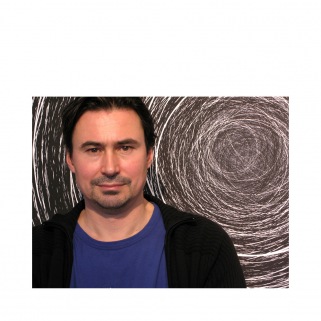
Fuelled by a fascination for exploring a visual paradox, for more than 20 years French artist Pascal Dombis has been charting new territory in the field of new media and computer art. Dombis has been using computers and algorithms to produce excessive repetition of simple processes. By computationally reproducing a geometrical or typographical sign, he creates destructuring structures and develops irrational environments. As a result there is a great paradox at the heart of Dombis’ work between orderly control of a simple rule and unpredictable results. The process is simultaneously random and mechanical, a machine creates the rule but the resulting artwork effectively takes on a life of its own.
Pascal executes his unique approach to interpreting the complexities of visual environments with continual originality. Whether creating lenticulars, light drawings, video works or installation, the paradoxical imagery, which faces the viewer, creates a strange feeling - one of intrigue, uncertainty and a strange satisfaction. For it is in the ever-shifting qualities of the layered convoluted shapes and symbols within the works that make the viewer truly aware that it is he or she that alters what he or she sees.
In his video work, the artist animates real-time line movements and their progression as they duplicate and become increasingly chaotic. Digital prints, on the contrary, freeze those movements at a certain moment, as if time were suspended for a while. When the digital prints are covered with lenticulars (functioning then as optical lenses), the number of points of view grows and multiplies according to the viewer’s physical displacements or changing angles of vision. Thus, every new piece offers plays on lines, stripes, and rhythms and chromatic variations, which open up to new spaces and give to the whole a highly pictorial dimension. Trained as a painter with a keen eye for the importance of aesthetic harmony in his work, Dombis enriches his compositions with colour, which is commanded by a random access programme.
It is with great excitement that The Cat Street Gallery presents the hotly anticipated solo exhibition 'Eurasia', showcasing Dombis' latest body of work in 2012.
Returning to Hong Kong with his second exposition at the gallery, Pascal's latest series of hypnotic works pack a powerful sensory punch.
It is particularly thrilling for us to represent such an artist here in Asia as it is a place key to this series of works - where a philosophical meeting of 'East' and 'West' results in a powerful aesthetic. This is highly detailed work built on a huge conceptual scale - charting an allegorical journey across a 'continuous continent' - cemented by the ideas of both great philosophers and artists: Nietzsche and Beuys. Pascal displays an unmistakable talent and vision for a new way of seeing: finding coexistence between order and chaos in a post-modern world.
Powered by self-designed algorithms or through harnessing a multitude of images from the internet and Google, Pascal's climactic yet unpredictable 'immense digital tapestries' have set his artwork apart form any other. Acquired by both international museums and private collectors alike, Pascal Dombis has an unwavering effect on those who see his pieces and read into the questions posed. We greatly look forward to bringing such an exciting body of work to Asia, and invite everyone to come and see this unmissable exhibition for themselves.
Dombis has exhibited widely throughout Europe, the U.S. and even Japan. His work is included in permanent collections including the Block Museum in Chicago and the Musee des Beaux Arts.